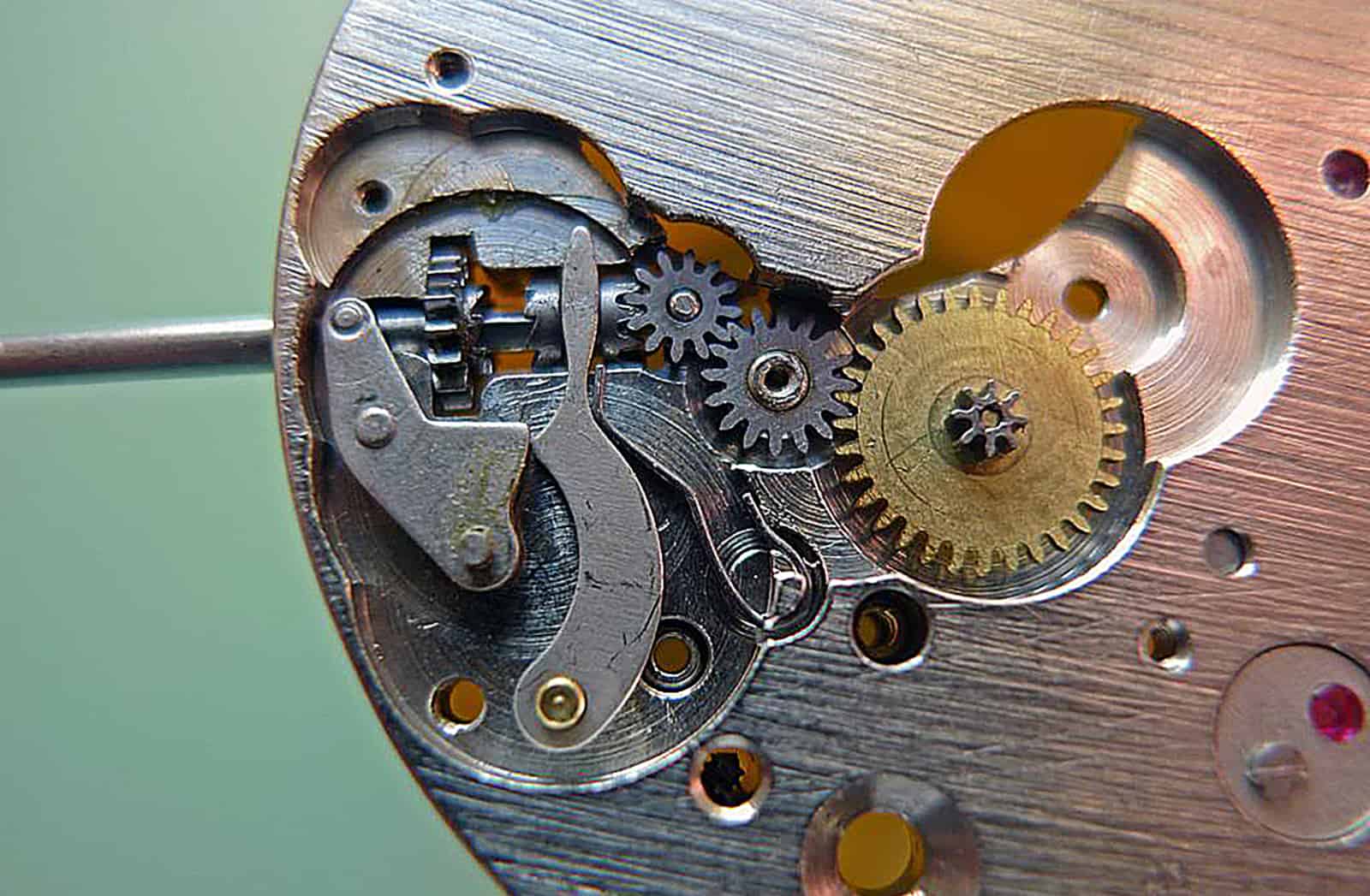
Most people who wear a watch have only a vague sense of what's happening inside it. That's entirely fine — a watch doesn't require you to understand its mechanism to use it. But a basic understanding of how the movement works helps explain why certain maintenance habits matter, what causes common problems, and what a service actually does.
The Two Types of Movement
All modern wristwatches fall into one of two categories: mechanical or quartz. The distinction is about how time is measured — specifically, what component provides the regular oscillation that the movement uses to count out equal intervals.
Mechanical watches use a balance wheel and hairspring as their oscillator. Quartz watches use a tiny quartz crystal. Everything else — the gear train, the power source, the hands — serves the same fundamental purpose in both types: delivering energy to the oscillator and translating that oscillation into the movement of the hands.
Mechanical Movements: How They Work
A mechanical movement stores energy in a coiled metal spring — the mainspring — which lives inside a cylindrical container called the barrel. When you wind a manual-wind watch using the crown, you're tightening this spring. When an automatic watch is worn, a weighted rotor pivots with wrist movement and winds the spring through a set of gears.
As the mainspring slowly uncoils, it releases energy through the gear train — a series of wheels and pinions that step down the speed and regulate the delivery of power. Left unchecked, the mainspring would uncoil rapidly and all the energy would release at once. The escapement is what prevents this.
The Escapement
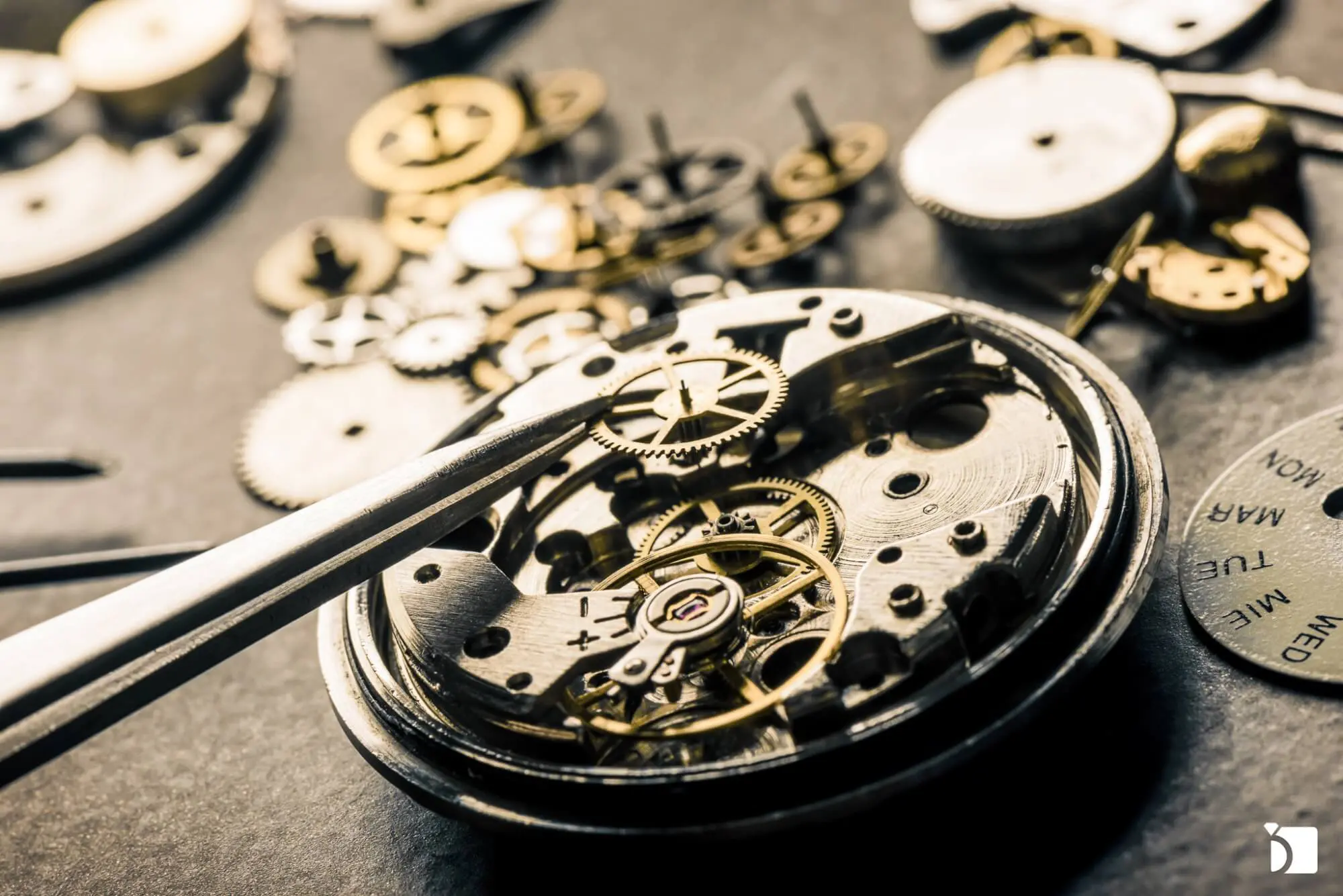
The escapement is the most distinctive and mechanically elegant part of a watch movement. It consists of two main components: the escape wheel (a wheel with specially shaped teeth) and the pallet fork (a lever with two angled faces called pallet stones). The pallet fork engages and releases the escape wheel in a controlled rhythm — allowing one tooth of the escape wheel to pass with each swing of the balance wheel.
The balance wheel is the oscillator: a weighted wheel connected to a hairspring that causes it to rotate back and forth at a consistent rate. This rate — the frequency — is typically expressed in vibrations per hour. A common frequency for Swiss movements is 28,800 vph, which means the balance wheel completes 4 full oscillations per second. Each oscillation allows one tooth of the escape wheel to pass.
This is the tick you hear in a mechanical watch. Each tick is the sound of the escapement engaging and releasing. The consistent rate of the balance wheel's oscillation is what keeps time.
Why Lubrication Matters So Much
The escapement components move continuously, at high frequency, with very small amounts of force. The surfaces that contact each other — pallet stones on escape wheel teeth, jewel bearings on pivots — need to be lubricated with specific oils and greases to reduce friction and prevent wear. These lubricants don't last indefinitely. Over five to eight years, they thicken, migrate, or dry out. When they do, friction increases, accuracy degrades, and component wear begins to accelerate.
This is the mechanical reason that a watch service is a maintenance requirement rather than an optional luxury. It's not about fixing something broken — it's about renewing the lubrication before the consequences of degraded oils begin to compound.
Manual vs. Automatic Movements
The difference between a manual-wind and automatic movement is simply the winding mechanism. Manual movements rely on the wearer to wind the crown daily. Automatic movements include a rotor — a weighted semicircle that pivots freely around a central bearing. As the wrist moves during normal wear, the rotor swings and winds the mainspring through a set of transmission gears. The rotor can rotate in both directions, and a clever arrangement of gears ensures that either direction of rotation winds the spring.
Automatic movements can also be wound manually using the crown, which is useful when the watch has stopped and needs an initial charge before the rotor can take over.
Quartz Movements: A Different Approach
Quartz movements replace the mechanical balance wheel with a different oscillator: a tiny sliver of quartz crystal, electrically stimulated by a battery. When voltage is applied to quartz, it vibrates at a precise frequency — typically 32,768 vibrations per second. A circuit chip counts these vibrations and sends a signal once per second to a stepping motor, which advances the gear train and moves the hands.
The quartz crystal's frequency is far more consistent than a mechanical balance wheel's — it's affected much less by gravity, orientation, temperature changes, and variations in power delivery. This is why quartz watches are significantly more accurate than mechanical movements under typical conditions. A quality quartz movement might gain or lose a few seconds per month; a well-regulated mechanical movement might gain or lose a few seconds per day.
What Quartz Watches Need
Quartz movements have fewer moving parts than mechanical calibers and require less frequent servicing. The main maintenance requirements are battery replacement (typically every one to two years) and periodic lubrication of the gear train, which is far less frequent than mechanical service intervals. The gear train in a quartz movement moves much more slowly than in a mechanical caliber — once per second rather than multiple times per second — so lubrication lasts considerably longer.
The circuit, oscillator crystal, and coil in a quartz movement are sealed components that don't require maintenance, though they can fail over time. When a quartz movement fails electronically, the affected component is typically replaced as a unit.
The Complications
Any function beyond basic timekeeping is called a "complication" in watchmaking — not because it's problematic, but because it adds mechanical complexity. Date displays, chronographs (stopwatches built into the movement), moon phases, GMT hands, and alarms all qualify as complications. Each one adds additional components and engagement points to the movement.
For the watch owner, complications are largely invisible during normal use, but they become relevant during servicing. A movement with a chronograph has significantly more components than a simple three-hand movement, which affects the time and complexity involved in a full service.
Understanding Movement Quality
Not all movements are made to the same standards. The quality of the materials, the precision of the finishing, the tolerances to which components are machined, and the grade of lubricants used all affect how a movement performs and how long it holds up between services.
Certain Swiss and German manufacturers produce movements that are adjusted to perform consistently across multiple positions — face up, face down, crown up, crown down, and so on. These adjustments compensate for the effects of gravity on the balance wheel and result in more consistent timekeeping across different wearing orientations. A movement described as "adjusted to five positions" or "adjusted to six positions" has gone through this process.
Higher quality movements also tend to use higher grades of synthetic lubricants, finer tolerances in the escapement, and better quality alloys in the balance wheel and hairspring. All of these affect performance and longevity — both how accurately the watch runs and how long it holds up between services.
Why This Matters Practically
Understanding your watch's movement doesn't change how you wear it, but it does help explain the advice you'll get from a watchmaker. When we say a mechanical watch needs a service every five to eight years regardless of whether anything seems wrong, it's because the lubrication degrades on a schedule — not because of how the watch was used. When we mention that a watch has been magnetized, it's because the hairspring has been affected by a field that's changed its elastic behavior. When we talk about power reserve, we're describing how much energy remains in the mainspring.
A basic familiarity with what's happening inside makes all of this easier to follow, and makes it easier to understand the decisions involved in maintaining something that's worth maintaining.
Curious about what's inside your specific watch? Contact our team — we're happy to discuss what movement you're working with.